TECHNOLOGY
 The
technology commonly associated with and collectively called “RFID” extends
beyond the RFID tag
on a product. RFID system technology can be categorized into the physical
technology (RFID tag and RFID tag readers) and information technology
(Electronic
Product Code (EPC), middleware, Object Name Service (ONS) and Physical Markup
Language (PML)). Over the past two years, improvements in RFID physical
technologies and near worldwide adoption of RFID information technology
standards have resulted in enormous improvements to RFID system reliability and
accuracy.
The
technology commonly associated with and collectively called “RFID” extends
beyond the RFID tag
on a product. RFID system technology can be categorized into the physical
technology (RFID tag and RFID tag readers) and information technology
(Electronic
Product Code (EPC), middleware, Object Name Service (ONS) and Physical Markup
Language (PML)). Over the past two years, improvements in RFID physical
technologies and near worldwide adoption of RFID information technology
standards have resulted in enormous improvements to RFID system reliability and
accuracy.
RFID TAGS
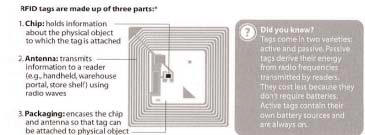
 An RFID tag is an electrical device placed onto a product, be it at the pallet,
case or individual item level. An RFID tag is composed of a computer chip, an
antenna integral to the tag, a battery in active tags, and packaging to encase
the components. The computer chip can store up to 128 Kbytes of information and
is essentially the same as other computer chips in use.
An RFID tag is an electrical device placed onto a product, be it at the pallet,
case or individual item level. An RFID tag is composed of a computer chip, an
antenna integral to the tag, a battery in active tags, and packaging to encase
the components. The computer chip can store up to 128 Kbytes of information and
is essentially the same as other computer chips in use.
The computer chip contains the Electronic Product Code for the product, and
based on application and tag capabilities, can store other information such as
environmental conditions experienced by the product or if GPS equipped, the
products location.
Passive tags
utilize the RF
energy of the RFID reader (via induction) to power the tag. The effective range
of passive tags is approximately 5 to 15 feet, and the tag is read only.
Active
and semi-active tags contain
batteries and transmit using power from the battery or a combination of the RFID
reader RF energy and the battery to power the
tag. Active tags have much greater range (as far as hundreds of feet depending
on size and transmission frequency), and have read/write capabilities. RFID
tags operate across the frequency spectrum, from low frequency (30 to 500 KHz),
thru ultra high frequency (800 to 900 MHz) to microwave frequencies (1 to 2
GHz). 1
RFID READER
The RFID reader is a scanning device that is capable of reliably reading
and communicating with RFID tags beyond line-of-sight, and the RFID middleware.
The RFID reader uses its own antenna to communicate with the tag by transmitting
RF energy at a designated frequency associated with the tag, causing the tag to
respond with EPC data embedded in the tag’s computer chip. Readers can
communicate and process information
from multiple tags nearly simultaneously, with current read rates of
approximately 100 tags per seconds, with estimated reliable read rate of over
1000 tags per second within the next year. Readers can be mobile, hand held, or
stationary such at point of sale readers and large entranceway portal readers.
1
ELECTRONIC PRODUCT CODE (EPC)
 The EPC is a
unique number that identifies a specific item in the supply chain and is stored
on the RFID tag. The standardization of EPC Class 1 Generation 2 codes (Gen2)
in December 2004 by EPCglobal 3 set the standard for EPC codes for
worldwide adoption. Most EPC Gen2 codes are 96-bit and are broken down into
four groupings: (1) “Version” or “Header” consisting of 8-bits and is designated
by EPCglobal and identifies the length, types, structure and generation of the
EPC, (2) “Domain Manager,” consisting of 28-bits, is specified by EPCglobal and
identifies the manufacture, (3) “Object Class,” consisting of 24-bits, is
assigned by the manufacture, and (4) “Serial Number,” consisting of 36-bits, is
assigned by the manufacture and used to identify the specific product (be it at
the pallet, case or individual item level). Worldwide acceptance of EPCglobal
is a significant milestone for RFID systems and will allow those firms complying
with the standard to utilize RFID generated data throughout their supply chain.
2
The EPC is a
unique number that identifies a specific item in the supply chain and is stored
on the RFID tag. The standardization of EPC Class 1 Generation 2 codes (Gen2)
in December 2004 by EPCglobal 3 set the standard for EPC codes for
worldwide adoption. Most EPC Gen2 codes are 96-bit and are broken down into
four groupings: (1) “Version” or “Header” consisting of 8-bits and is designated
by EPCglobal and identifies the length, types, structure and generation of the
EPC, (2) “Domain Manager,” consisting of 28-bits, is specified by EPCglobal and
identifies the manufacture, (3) “Object Class,” consisting of 24-bits, is
assigned by the manufacture, and (4) “Serial Number,” consisting of 36-bits, is
assigned by the manufacture and used to identify the specific product (be it at
the pallet, case or individual item level). Worldwide acceptance of EPCglobal
is a significant milestone for RFID systems and will allow those firms complying
with the standard to utilize RFID generated data throughout their supply chain.
2
MIDDLEWARE
Middleware, also known as RFID
manager software, integrates the various data transmitted by RFID tags being
processed by one or more RFID readers, making the data useable by other supply
chain management software. The middleware processes as close to the source as
possible, filtering out non-essential and multiple receipt of the same RFID tag
information. The middleware further formats the RFID data for transmission via
intranet or the Internet. Additionally, middleware also includes tools to
monitor and control RFID readers and other functions of the local RFID system.
1, 3
OBJECT NAME SERVICE (ONS)
The ONS provides a
global lookup “service” to translate EPCs into common Internet Uniform Reference
Locators (URLs) where more detailed information on the item tagged is retained.
These EPC URLs can identify an EPC Information Service, an EPC website or other
Internet resource containing information on the product. ONS was developed as
an “open architecture” (similar to the Internet) and allows EPC data to be
quickly and efficiently transmitted over the Internet. ONS allows EPC tagged
products to be linked in real time to existing information or record real-time
obtained information of the product as it moves through the supply chain.
2
PHYSICAL MARKUP LANGUAGE (PML)
“PML is a collection of common, standardized XML vocabularies to represent
and distribute information related to EPC Network enabled objects.” PML is
EPCglobal and the RFID industries’ attempt to standardize interfaces and
protocols for the communication with and within EPC Information Service of
physical information concerning the product tagged. Examples of PML data would
be the location the where an EPC was read, the products weight, dimensions, and
other physical and environmental condition data known about the product. 2,
4